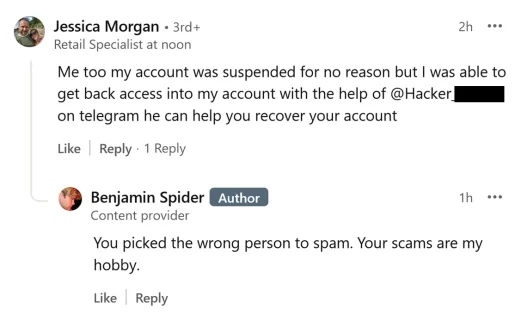
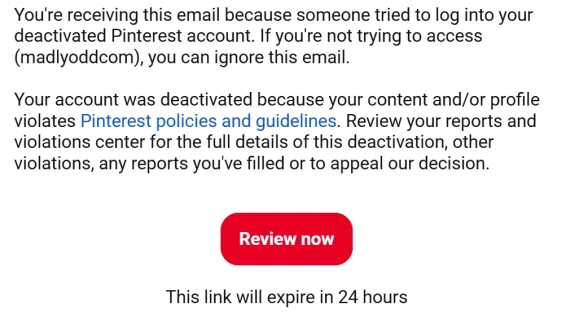
- Stolen Pins in Feeds: Pinterest recommends stolen content in feeds, recommendations, or through searches. Users interact with it by clicking, commenting, repinning, saving, and/or reporting it.
- Repinning to Manipulate Algorithms: Accounts stealing content may repin legitimate content from the creator’s account, embedding it within a web of spammy or stolen pins. While I don’t believe this plays a big part in recommendations, I do believe that if Pinterest’s systems detect that an account’s pins are being repinned by these spammy accounts, it could reinforce the association between a user’s account and problematic activity, resulting in penalties against legitimate content.
- Reporting Triggers Spam Designation: If enough users report stolen pins as spam or misleading, Pinterest’s systems may flag all similar pins, including the creator’s originals.
- Impact on the Original Creator: Pinterest’s systems, unable to distinguish the true source, could mistakenly penalize the creator’s legitimate content or account.
- Engagement Manipulation: When stolen content uses deceptive tactics (like fake play buttons), it often generates higher engagement metrics. Pinterest’s algorithms then view the original content as less engaging by comparison, leading to reduced visibility and potential flagging.
- Domain Association: When stolen content leads to suspicious sites (particularly through those Blogspot redirects), Pinterest’s systems may begin associating the original content’s visual patterns with suspicious behavior. This is especially damaging when stolen versions maintain similar visual elements to the originals.
This creates a vicious cycle: When a legitimate account gets flagged, more stolen versions of their content appear during the suspension period. As users interact with these stolen versions (often unknowingly), it becomes increasingly difficult for the legitimate account to recover. Pinterest’s algorithms continue to favor the engagement metrics of stolen content, making it harder for the original creator to regain their standing even after reinstatement.
Pinterest Would also Suspend Offending Accounts, Right?
Well, no, because… Metrics… and ad revenue
This raises a critical question: Why aren’t all offending accounts suspended if Pinterest’s algorithms can detect themes and connections between pins?
The answer lies in Pinterest’s prioritization of engagement metrics over content integrity. Offending accounts generate high activity levels through deceptive tactics like fake play buttons and misleading redirects. While these behaviors harm creators and users, they drive the metrics Pinterest values. I suspect this generates more impressions and engagement than legitimate content – specifically, more pin clicks (not URL clicks) per impression than original pins receive.
Here’s the key: Every time someone clicks to expand a pin, Pinterest displays more ads. This effect is amplified by stolen pins that have been altered with fake play buttons (remember those Blogspot redirects I mentioned earlier). Users are more likely to click on what appears to be a video, triggering ad displays, only to be shown more stolen content (possibly yours), leading to more clicks and more ads. Pinterest appears reluctant to suspend these accounts because they’re essentially engagement machines driving ad revenue, regardless of the damage they do to the platform’s ecosystem.
The Replacement Effect
When Pinterest suspends a legitimate account, it inadvertently creates a vacuum that previously stolen content fills I call this the “Replacement Effect” – where Pinterest’s systems gradually start associating your original content with the counterfeiters who stole it, rather than with you, the creator. This creates a compounding problem: not only is your account suspended, but the stolen versions of your content are actively replacing your brand’s presence on the platform.
Think of it as digital identity theft that Pinterest’s algorithms actively reward. While your account is suspended, counterfeiters continue using your content, building engagement metrics, and establishing themselves as the “authentic” source in Pinterest’s system. The more successful these stolen pins become, the harder it becomes to reclaim your content’s rightful place – even after your account is reinstated. This problem manifests in several critical ways:
Hurdles to DMCA Claims During Suspension:
- When suspended, creators lose access to their account history – the very proof needed to file DMCA claims
- Pinterest routinely dismisses clear evidence of theft with “After careful review, we don’t see any plausible infringement here. As a result, we have not disabled access to the reported content”
- The combination of account suspension and dismissed DMCA claims creates a perfect environment for counterfeiters to thrive
Brand Damage and Trust Erosion:
- Users encountering malware and redirects from stolen content blame the original creator, not the thieves
- This damaged trust persists long after account reinstatement
- New users discovering content through counterfeits form negative first impressions that are hard to overcome
- The time spent fighting DMCA dismissals prevents creators from focusing on rebuilding their brand
The Compounding Effect:
- While creators are suspended and unable to defend their content:
- Counterfeit pins remain visible and gain traction
- Stolen content continues drawing traffic away from legitimate creators
- Pinterest’s algorithm favors the artificially inflated engagement of stolen content
- Post-reinstatement recovery becomes increasingly difficult as:
- The audience base has diminished
- Trust needs rebuilding
- Creators must split resources between recovery and ongoing theft prevention instead of content creation.
A Harmful Pattern
Every suspension of my accounts has coincided with an influx of stolen content. This surge isn’t coincidental – while legitimate creators are suspended and struggling with dismissed DMCA claims, counterfeiters freely exploit their content. This suggests a troubling pattern: as stolen versions of legitimate work proliferate, Pinterest’s systems are unable—or unwilling—to distinguish between creators and those exploiting them. Instead of protecting creators, Pinterest’s algorithms compound the harm by prioritizing metrics over verifying authenticity.
If my theory is true, it raises serious concerns about Pinterest’s approach to content verification. By prioritizing engagement metrics over content integrity, the platform may unintentionally punish creators for crimes committed against them. Even worse, creators must waste precious time and resources fighting this system while their revenue streams are cut off, creating a perfect environment for counterfeiters to thrive.
Will Advertising prevent an account suspension?
No, at least not for those who spend tens of thousands a year.
In fact, Pinterest’s ad department was ready to kick me to the curb when I got caught in the mix – despite previous assurances that I could contact my sales rep if this happened again. This reality raises two disturbing questions:
- How many fake accounts are spending that kind of money on ads?
- Why would anyone advertise on Pinterest if they could just game the system and not be affected?
These are questions only Pinterest can answer. Their silence speaks volumes about their priorities.
The Impact on Legitimate Personal Accounts
No, I did not forget about regular users because there would be no Pinterest without you.
I find it puzzling that accounts that do nothing more than repin content are suspended, many of which keep well-curated boards. Take my personal account, which I don’t use for business – I pin plants I want, things I want from Ikea, fish, and home improvements (that I would have to hire someone to do in order to avoid a cataclysm if I did it myself). All of these pins go to specific, organized boards. Curation is not the word I would use for any of the spam accounts I have reported. I am certain that board organization is not a metric that Pinterest considers when suspending accounts. While yes, I believe curation plays into recommendations for other pins and board descriptions (another factor that Pinterest does not account for), it certainly doesn’t factor into how Pinterest handles the spam accounts I’ve reported.
There was an account I saw months ago that had a board with over 200 pins about pickle recipes. At first, I thought this couldn’t be real, but it was. The boards of this account were all of culinary interest; it had thousands of pins. All were carefully curated according to specific criteria, with detailed descriptions. As far as I could tell, not one pin led to anything unrelated to their pins. This highly valuable account was positive overall for the Pinterest community. However, I have seen Pinterest suspend accounts like this, and I believe these suspensions have harmful consequences for what appears in people’s feeds.
I have not had my account suspended, but I can speculate how they also got caught in the mix (which may updated):
- Interaction with Stolen Content:
Personal accounts engaging with stolen pins—whether by repinning, saving, or reporting them—may inadvertently become part of Pinterest’s engagement data for these pins. This interaction could lead Pinterest’s algorithms to view the personal account’s activity as problematic, particularly if the stolen pins are flagged multiple times. Nevermind that Pinterest likely suggested those Pins to the user. The user may have only pinned it due to a picture (as accounts gaming the system like to steal images from stock media sites), never to click on the outgoing link.
- Association with Spammy Activity:
If Pinterest’s systems are unable to distinguish between legitimate engagement and intentional spam, personal accounts that repeatedly interact with flagged pins could be incorrectly categorized as part of a spam network, resulting in unwarranted suspensions or penalties.
- Algorithmic Overreach:
Pinterest’s reliance on engagement-driven metrics means that personal accounts engaging with stolen content may get swept up in enforcement actions aimed at removing spam. Instead of targeting only the offending accounts, Pinterest’s broad enforcement approach could lead to innocent personal accounts being suspended.
- Ads and Engagement Incentives:
Personal accounts might also be indirectly harmed by Pinterest’s financial incentives. The presence of ads beneath stolen content encourages Pinterest to keep these pins visible longer than they should be. Personal accounts interacting with such content are caught in a system where engagement is rewarded over authenticity, leaving them vulnerable to suspensions if flagged content is linked to their activity.
- Old Pin Interactions: Regular users who save or interact with older content (like going through archived pins or old boards) might trigger suspensions if those pins were later identified as spam but remained in their collections. Personal accounts with years of saved content might not realize some of their older saved content has become problematic.
- Group Board Associations: Regular users participating in group boards might get caught in suspensions if those boards later become targets for spam networks or if other contributors to the board engage in suspicious behavior.
- Rapid Clean-Up Activity: Personal accounts that suddenly delete multiple pins or boards (like during a profile clean-up) might trigger automated systems that interpret rapid deletion as suspicious behavior, similar to how spam networks sometimes purge content.
Regular users who curate content and engage naturally with the platform face penalties, while networks of fake accounts continue to thrive. This undermines the ecosystem that makes Pinterest valuable in the first place.
The Impact of Pinterest’s Failed Policies
Pinterest’s lack of effort in addressing fake accounts creates a devastating ripple effect across their entire ecosystem. By favoring networks gaming their system, they’re damaging every legitimate participant on their platform:
Advertisers Face Wasted Spend – Advertisers invest in Pinterest expecting a brand-safe platform that effectively reaches real users. However, Pinterest’s failure to address counterfeit content, stolen pins, and harmful links undermines this trust. When ads appear alongside fraudulent or malicious content, the credibility of Pinterest as an advertising platform comes into question. Advertisers may not face direct liability, but their association with harmful or misleading content reflects poorly on Pinterest’s ability to uphold advertising standards.
From a regulatory standpoint, Pinterest’s negligence could lead to significant scrutiny. The FTC requires platforms to ensure that advertising practices meet consumer protection standards. By allowing ads to appear next to phishing schemes, malware, and counterfeit content, Pinterest risks fines and regulatory action for failing to provide a safe and transparent advertising environment. These lapses jeopardize Pinterest’s relationships with advertisers, threatening future revenue and exposing the platform to long-term reputational damage.
Regulatory Red Flags -Pinterest’s systemic failure to address stolen content and enforce DMCA compliance raises serious regulatory concerns. Beyond facilitating copyright infringement, Pinterest has allowed networks of counterfeit pins to redirect users to malicious domains. These outgoing links expose users to phishing schemes, malware infections, and spyware, creating a significant cybersecurity risk. Despite receiving detailed reports and evidence of these violations, Pinterest has taken little action to mitigate these threats.
This negligence not only undermines the Digital Millennium Copyright Act (DMCA) but also violates consumer protection laws enforced by the FTC. By allowing harmful links to proliferate unchecked, Pinterest jeopardizes user safety and violates its responsibility to maintain a secure platform. Such inaction could trigger regulatory investigations and result in significant penalties, further eroding Pinterest’s credibility and trust among users and advertisers.
Content Erosion As legitimate creators and businesses abandon the platform or reduce their efforts, Pinterest loses the very content that made it valuable. When stolen, low-quality content dominates the platform, it degrades the entire user experience.
The Most Critical Loss: Regular Users Most importantly, Pinterest is losing its foundation – regular users who curate authentic content and engage genuinely with the platform. As these users face suspensions or leave in frustration, Pinterest sacrifices the community that built its success in favor of artificial engagement from fake accounts.
Pinterest, if you are reading this, I have suggestions.
To create a healthier environment, Pinterest must prioritize legitimate users over artificial engagement. Here are crucial changes needed:
Smarter Account Review Process
- Account History Evaluation
- Consider account age and consistent activity patterns
- Review long-term pinning behavior and board curation
- Examine the quality of board organization and pin descriptions
- Assess pattern of user engagement over time
- Personal Account Protections
- Implement safeguards for established personal accounts
- Create clear appeal paths for legitimate curators
- Develop better metrics for identifying genuine personal use
- Consider user’s history of content organization and themed collections
Stricter Content Control
- URL Management
- Limit accounts to one outgoing domain per business identity (i.e. account)
- Require domain verification before allowing outbound links
- Implement stricter monitoring of URL redirects. (as I know, Pinterest does with ads.)
- Create better systems for tracking sudden changes in link patterns
- Platform Integration
- Establish a stronger partnership with Google/Blogspot (This is also a Google problem)
- Create shared enforcement mechanisms for cross-platform abuse
- Implement automatic suspension sharing between platforms
- Develop better tracking of redirect chains, as Pinterest does not block all redirect services.
- New Security Measures
- Improve detection of fake play buttons and deceptive imagery (Facebook does this, and you can’t publish an ad with one)
- Create better systems for identifying template theft
- Implement proactive monitoring of sudden content duplication
- Develop tools to track and prevent mass content scraping
A Note to Pinterest
I am not trying to destroy Pinterest.
Pinterest, if you are reading this—and I hope you are —you offer a unique social media experience and a unique audience that sets it apart from other platforms. I have invested my own personal time in providing feedback whenever asked Because I felt invested in the platform; after all, I made a living off of it. As someone deeply committed to the health and authenticity of Pinterest, I implore you to consider the challenges we, as creators and users, face due to the current oversight and enforcement practices. I ask for a commitment to transparency, accountability, and a reinvigorated focus on the creator community, which forms the backbone of your platform. Together, we can ensure Pinterest remains a vibrant, innovative space where creativity is safeguarded and celebrated.
Is Your Pinterest Account Dead Forever?
I think that depends on if you keep trying to appeal your suspension, as it seems the only accounts that are gone are the ones that were given up on. I have witnessed accounts that stole my content come back, not realizing I am a data hoarder, and I do randomly check. But, when your account is reactivated, you might receive this message:
“I took a look and reactivated your account. Sometimes, good accounts get caught in the mix and get suspended by mistake. We’re sorry that happened.
If you have any further trouble, reach out again through our Help Center.
Thanks,”
I received this message after five months of suspension in 2020—ironically from the copyright department handling DMCAs, likely because I’d submitted thousands of claims with proof they weren’t being handled properly (the superpower of ADHD, as we can overload people with information, and given I am a database nerd, nuclear grade overload). I had planned to start advertising on Pinterest when the suspension hit, which delayed my advertising plans by over two years. Pinterest doesn’t consider the consequences to the overall user experience, they didn’t consider the revenue impact of my suspension—from September 2022 until this recent suspension, I spent $80,000 on their platform. The irony is, as with the previous suspension, I was about to increase my advertising budget.
The consequences of getting “caught in the mix” don’t just affect users in the long run. Pinterest must consider the long-term impact these suspensions have on its platform’s ecosystem.
The Road Ahead
As I keep saying, I have ADHD, and that first D should stand for dysfunction, as I am going to obsess over this until they do something. Hence, how Hosting-reviews-exposed.com got started, and when the cheap hosting industry started to enforce the 2009 FTC guidelines, my interest went away. Unfortunately, Copytrack woke that drive backup, and I am certain they regret how I built a strategy for dealing with their copyright claims (The whole stock images do not cost as much as they want). I will use my powers of annoyance and ADHD to make sure they notice us.
If you’ve experienced similar issues, want to rant, or found something I haven’t (that whole dopamine thing leads to tunnel vision sometimes), consider sharing your story in the comments below. The more we document these patterns, the harder they become to ignore. While I can’t promise immediate solutions, I can promise to keep investigating and sharing what I find.
Next up: I’ll be diving deep into the Blogspot connection. Stay tuned.
Thanks for reading. Have a wonderful day.