
This post in regards to Pinterest is a work in progress, and to serve a reference for my on going posts about my experience with Pinterest.
Note: This is going to be a mess as I combine my notes and previous posts on other platforms in one place. However not everything will be published here yet as I want to double confirm before I add. But, this will also serve as to a wider explanation to what spam affiliate networks are.
Please pardon the mess.
Spam Affiliate Networks/Syndicates on Pinterest
This is an organization that involves two parties:
- Network Operators (e.g., PublyMedia.com, Kueez.com, Static.com, Viralagain.com)
- These companies own multiple sites
- They create affiliate programs to drive traffic to their sites
- They provide tracking URLs that allow them to monitor referral sources
- Independent Publishers/Affiliates
- These are affiliates who manage multiple Pinterest accounts
- They often steal content because it performs better than original pins
- Some networks require affiliates to manage 50+ social media accounts
I should note that for now, I don’t know if certain sites like Boredpanda.com are operating their own affiliate networks independently or if they’re working with third-party services that distribute their content through affiliates. This is something I’m still looking into.
Understanding How I Connected These Accounts
While filing copyright claims, I noticed a pattern in the URLs these spam accounts were sharing. One particular network stood out when I discovered a common tracking code linking 73 different accounts. These accounts were all driving traffic to multiple domains using the same exact tracking code:
utm_campaign=dist&ly=native_one&mbid=enou0arwiryzy7kn_4f4bc6
UTM tracking codes like this are typically used by website owners to track where their visitors come from. In the case of spam affiliate networks, they allow operators to monitor which Pinterest accounts are driving the most traffic to their sites.
For example, the URL: https://www.scientistplus.com/en/funny-even-us-love-photobombs?utm_source=pinterest&utm_medium=aff&utm_campaign=dist&ly=native_one&mbid=enou0arwiryzy7kn_4f4bc6
This same URL with the exact tracking code appeared in 158 stolen pins across 73 different accounts.
By embedding identical tracking codes in multiple stolen pins, network operators know who to pay, and could analyze engagement, refine their tactics, and optimize their reach.
The patterns I have observed with account management seems designed to evade detection – accounts are typically abandoned before reaching 200 pins, with new accounts created to replace them, though some exceptions grow to thousands of pins before being abandoned. Longest period since an account last posted was 2 years. For accounts specifically stealing my content, the longest time since their last post was 1 year ago. I believe they deliberately stop posting as a tactic to avoid detection, despite continuing to steal content. I think this began at most 3 years ago, with the content theft starting around mid-2023. This timing coincides with the gradual loss of traffic I started experiencing since August 2023.
Keep in mind, I have only recorded the content they stole from my accounts. But I observed these accounts posting the same exact URL on pins. They may do 2-5 different sites, but the same exact URL for each site. While other accounts vary the URLs to some degree. Notably, these stolen pins have no descriptions, and the titles almost never match the pin content.
These patterns further demonstrate the systematic nature of their operation. The variation in URL behavior (some using identical URLs across pins while others vary them) strongly indicates different individuals operating within these networks, each with their own methods but working toward the same goal. By using identical URLs across multiple pins and sites, they’re creating a concentrated traffic funnel to specific landing pages, maximizing their affiliate earnings. The lack of proper descriptions and mismatched titles indicates automated or bulk publishing without concern for content quality – their only goal is driving clicks.
This behavior also makes it easier to trace connections between seemingly unrelated accounts that are actually part of the same network. The identical URL pattern serves as a fingerprint linking these accounts together, further confirming the coordinated nature of their activities and providing additional evidence of Pinterest policy violations.
In the case of Kueez’s network, I believe they initially used their own pins but discovered that stolen content performed better. It should surprise no one that a system designed to game Pinterest’s algorithm would eventually sponsor content theft, as affiliates seek higher-performing pins to maximize their earnings.
At the time of contacting Pinterest on January 5th, 2025, I had identified 27 domains participating in these networks. Since then, that number has grown to 51 confirmed domains engaged in this type of activity.
It’s important to note that even if these affiliates weren’t stealing content, their operations would still violate multiple aspects of Pinterest’s spam policy, including:
- “Don’t create or operate accounts that aren’t authentic, create accounts en masse…”
- “Don’t create or save content that is repetitive, deceptive, or irrelevant in an attempt to make money.”
- “Don’t operate multiple accounts or coordinate with other people with the purpose of manipulating the Pinterest platform.”
- “Don’t use any other unscrupulous tactics to attempt to improperly influence distribution, clicks, or other metrics…”
- “Don’t attempt to evade our anti-spam systems.”
Networks like PublyMedia explicitly require affiliates to manage 50+ social media accounts, which directly contradicts Pinterest’s policies against creating accounts en masse or operating multiple accounts to manipulate the platform.
Known Spam Affiliate Networks
From my LinkedIn posts that I will expand on later:
Publymedia.com
Notably after Pinterest executives saw my LinkedIn post, Dijibi.com, belonging to this company was blocked for spam, however, I still see there are accounts active, meaning they will just move onto the next scam.
I discovered PublyMedia.com by clicking on what seemed like an account link at the top of Dijibi.com, which led me to a page that said, “Apply Now” and “Only expert publishers are accepted.” PublyMedia is actively seeking affiliates to sign up and flood social media platforms like Facebook, Pinterest, Twitter, and Reddit with spammy, repetitive content. To participate, affiliates are required to manage a minimum of 50 social media accounts across any combination of these platforms (I’m assuming this is per platform, not across all of them), which is a clear attempt to game the system by maximizing the number of accounts used to promote their links. This violates the policies on platforms like Facebook and Pinterest, and while Twitter may not have much oversight under Elon Musk, it still contributes to the broader issue of platform abuse. I certainly do not see Reddit users acting favorably towards this, but I could be wrong.
Here are the domains in their network:
Dijibi[.com]
Homehacks[.com]
Swagbae[.com]
Kindergartenworksheet[.org]
Saltabae[.com]
Fashionisms[.com]
Dijibi[.com] has been listed in my DMCA complaints involving 50 images, benefiting from traffic driven by content stolen from my accounts.
On the same page that allows you to apply to be a publisher, I noticed a link showing what content to promote. Affiliates can enter their tracking parameters, and PublyMedia generates links with their tracking alongside a list of titles and URLs, but there are no actual Pins provided. This process seems like it should be hidden behind a login, as it lacks the necessary oversight and transparency.
I have no idea if the other networks are the same. But, they have the same problem of content theft, never mind the policy violation of gaming the platform through multiple accounts. But, this could be why these accounts steal content:
– Networks only provide tracking URLs, not actual pins
– Networks expect affiliates to create pins for them.
– Stolen pins perform better than original content. (I think this is he most likely option) there may be a login area I am not seeing that provides the pins.
When reviewing older accounts within these networks, I found what might have been legitimate Pins from these sites. However, these Pins do not follow Pinterest’s best practices, let alone my own rules for appealing Pins. This led me to believe that maybe they were stealing content because it garnered more clicks. It’s also possible that networks like PublyMedia either expect affiliates to create the Pins themselves or don’t provide them at all. Even if affiliates used Pins directly from the sites listed, they would still be violating Pinterest’s spam policy by enabling these companies to game the system through their networks.
Kueez.com
This going to be my first post about the accounts on Pinterest that vagrantly violate their policy on spam. I discovered these accounts when they were stealing my content. They violate Pinterest’s spam policy which prohibits ‘gaming the system,’ yet large networks of interconnected sites recruit affiliates to create mass Pinterest accounts that manipulate engagement.
At first, when I was investigating, I assumed that all of these domains were part of the same network because every URL I collected for content stolen from my accounts had tracking (UTM). I had also assumed they were part of the same network because initially, I was seeing the same six domains at the time. However, the more claims I filed, the more domains I found, and the pattern started to become clearer as I continued filing DMCA claims. After comparing the different domains’ tracking, I realized they were part of multiple networks operated by different individuals. Industrial-Scale Platform Manipulation Operation (I am still thinking of a term for this).
On January 5th, I informed Pinterest of 72 accounts, 38 of which were still active (but, was silently deleted) that were pushing traffic to Scientistplus[.com] and five other domains Boredpanda[.com], oppisumsauce[.com], juststarz[.com], luxurlist[.com], rightlivin[.com], and romanticfeed[.com], linked to 343 stolen images just from my accounts filed. Keep in mind, they were stealing from others. Subsequently, I identified another account and additional domain (reallifediy[.com]) using the same affiliate code, which was filed shortly after I informed them by email and fax. 4 of those accounts were promoting boredpanda[.com] through different tracking. utm_source=zeshan&utm_medium=link&utm_campaign=ars
What links all of these domains? Other then Boredpanda[.com], all of these sites belong to Kueez, which can be found on the bottom of each sites listed. I am still looking to see how “Publishers” sign up to promote their content, and to see how much they pay. Never mind, that they violate almost every part of Pinterest’s policy on spam.
A full list of the domains I have found these accounts promoting from this network, and the amount of claims I have filed against them:
juststarz [com] – 65 claims
luxurlist [com] – 9 claims
opossumsauce [com] – 6 claims
rightlivin [com] – 50 claims
romanticfeed [com] – 120 claims
scientistplus [com] – 196 claims
visualchase [com] – 2 claims
flamingoof [com] – no claims so far
realifediy [com] – 2 claims
thefunpost [com] – notably banned for spam
travlerz [com] Blocked for spam – Found 2/22/2025
Unidentified Network 1 (UN1)
(To be renamed when I identify it)
Upon review of some of the accounts I filed copyright claims against, I noticed multiple accounts linked to Travelermaster.com. As I re-reviewed these accounts before submitting them as proof of Pinterest’s failure, I found more sites engaged in this affiliate spam tactic. I think before January, I knew of around 20-30 sites, but I added 12 more just from these claims.
I am now calling this network Unidentified Network 1 (UN1).
I do not yet know which company operates UN1 or where affiliates sign up. Their domains information is private, the most I can tell is they were registered with Godaddy.com. I do know that:
At least six sites in UN1 share the same website theme as Travelermaster.com.
The Terms of Service on these sites were last updated on May 24, 2023, under Travelermaster.com.
They have the exact same Terms of Service, except for a single link at the beginning, which either directs to the site itself or a dead WordPress account.
Example:
Welcome to TravelerDreams – and thank you for visiting our website, available at:
https://stagingtrd.wpengine.com/ (the “Site”)
Some of these sites have appeared in other claims outside of claims with these specific accounts.
Some of these sites were being promoted by the 16 accounts I previously reported.
All of these sites use similar tracking codes in their URLs, linking them through affiliate payments and engagement tracking.
These six sites along with travelermasters.com are confirmed as part of UN1 based on their identical structure & shared ToS that was Last Updated: May 24, 2023:
Everydaymonkey.com
Sportsbanaza.com
Travelermaster.com
Travelerdreams.com
ThePrimaryMarket.com
YourSportSpot.com
TopPopToday.com
Disclosure: When I first reviewed Travelermaster.com in January, Avast blocked it from attempting to infect my machine. As of my latest check, it appears to no longer be actively distributing malware. However, given its previous infection, its connection to spam, and its involvement in UN1, I still consider it a high-risk site. Just because it isn’t flagged now doesn’t mean it won’t attempt to inject malware again in the future.
Here are the current list of sites I found, which fall into three catagories:
- I have found them through claims
- I found them on accounts I filed l claims against, and they have UTM tracking in the URLs. Also, I have filed no claims against.
- I found them through their parent company of sites I reported.
Note: Most of the data may not be up to date as this is not the sheet I am working from. (I am not really a fan of Google Sheets).
Boredpanda.com
Bored Panda has consistently appeared in my claims since October, because Pinterest is recommending content stolen from my accounts from their spam networks.
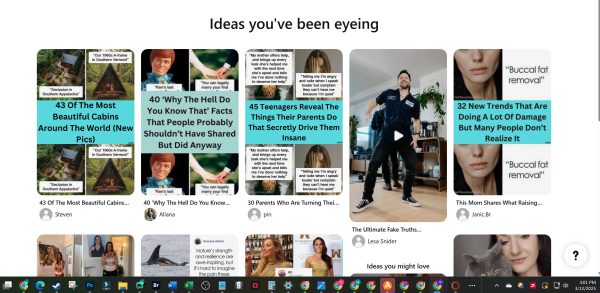
From the screenshot of recommendations, there are 9 accounts all with pins Pinterest notified me as “Ideas you’ve been eyeing” from Bored Panda’s spam network. This was also emailed to me in case I missed notifications, which is a great way to collect evidence (like the pins that were stolen from my accounts). None of the 9 accounts in the screenshots were included in my previous complaints. But, since content stolen from my accounts has been mixed with Bored Panda pins, Pinterest’s algorithm has started to associated my pins with their company.
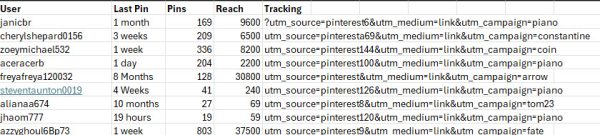
Reasons Pinterest should not be recommending these pins:
– Low quality / too small.
– Cluttered layout.
– No branding
Yet, their algorithm prioritizes them.
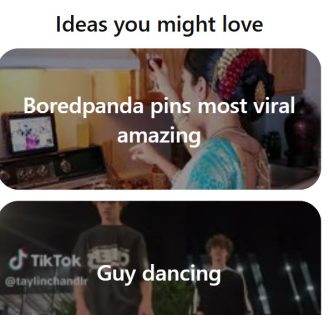
I have three theories on how Bored Panda is operating:
1. They are creating these networks themselves. I suspect this due to how basic the tracking is. They’re possibly acting as a publisher for Affiliate Networks.
2. They have an affiliate program (based on accounts that were affiliates with Kueez, Sharbly, and other networks also pushing traffic for Bored Panda).
3. They are operating with a third party that acts as a network for publishers/spam affiliates.
So far, I have filed claims against 37 accounts, plus Bored Panda has stolen 166 pins from my account. 8 pins were directly on their account. I am currently processing more claims in addition to addressing a larger Blogspot problem (which accounts for nearly 90% of the claims).
Note:
Even if they were not stealing content from other creators like me, they are clearly violating Pinterest’s Best Practices on spam:
– “Don’t create or operate accounts that aren’t authentic, create accounts en masse…”
– “Don’t operate multiple accounts or coordinate with other people with the purpose of manipulating the Pinterest platform.”
– “Don’t use any other unscrupulous tactics to attempt to improperly influence distribution, clicks, or other metrics…”
Yet, Pinterest itself is promoting their spam networks and content stolen from my accounts. This effectively disrupts user feeds.