In December, I shared my thoughts about why my Pinterest accounts “got caught in the mix,” but not a lot on my experience. While it seemed like I did, I held back a lot of details thinking Pinterest would come to its senses (ergo, not wanting to shout fire in a crowded theater). I thought maybe we could solve things together, as opposed to a prolonged battle because they have the power to make things right faster than I can bring this to the public’s attention. But now, I know they don’t care… which means they chose for things to be weird and unpredictable in a legal and ethical way.
When it comes to Pinterest, for once I will claim expert status
In the previous decade, I covered fake/undisclosed paid hosting reviews. In the hosting industry, I will always claim I was nothing more than an over-glorified administrator, which is a title I have claimed through my internet-based livelihood. I had been willing to hand over Hosting-Reviews-Exposed.com over to the right person, because I never felt I was the best person for discussing the topic of fake reviews. But if there is one thing that I ever feel confident in claiming expertise in, that would be Pinterest.
Before November 2024, I liked Pinterest over other social media channels. There was a clear method to establish a business, they put it right out there how to get noticed. I realize there are a few more tricks to the trade, which is where companies like Tailwind come in. But I have my own rules. For one, text should never dominate your pin. Make sure to stand out… there are more things I would have told you to do, but my key to success was also where things went wrong for me.
The problem was that I stood out, you would think that was a good thing, and you would have better protections when you did. Seriously… over 10 million views, the limit of how far Pinterest will tell others an account is getting, which I never understood why. But to avoid exposure given the elements I am covering, it was well past 10 million, and that is the extent of what I will reveal. As I said, my pins stood out, a clear recognizable trademark which made me a huge target for content theft. When I saw a dip in traffic, that meant someone was stealing my content.
Over the past year and a half, I should have realized that the slow drain of traffic was caused by spam affiliate networks that were gaining momentum, something I plan to cover later. Not to mention the Blogspot problem, which had been a problem since I started filing DMCAs and trademark removal requests, but not to the extent I am seeing now. Once Pinterest suspended my accounts, those who stole my content took my place. On my personal account, I now get recommended the content I created. Never mind that I paid for ads that helped boost their traffic. For nearly 4 months, I had hoped I could find someone at Pinterest that could be reasoned with.
One Last Good Faith Attempt
February 13–17, 2025
I reached out to nine key figures on LinkedIn:
- Bill Ready – CEO
- Bill Watkins – Chief Revenue Officer
- Jenny Donnelly – Head of Data Science
- Malik Ducard – Chief Content Officer
- Matt Madrigal – Head of AI & Personalization
- Martha Welsh – Chief Strategy Officer
- Michele C. Lee – Chief Legal & Compliance Officer
- Paul Rockwell – Head of Trust & Safety
- Wanji Walcott – Chief Legal & Business Affairs
Now, before we go forward, I do not condone uncivil behavior. You will get no support from me if you do. Be ethical, work within the law. They may not return it back, but the point is not to be like them. You act like they do, and you have already surrendered. Sarcasm, making things weird, doing the unexpected… I am here for that, and I will cheer you on. Be the person that makes me proud.
Anyway…
Keep in mind my accounts were a big part of my livelihood and had been suspended for three and a half months before I contacted them. This caused a lot of sleepless nights and anxiety, all of which have done wonders for my mental health (thanks a lot for that Pinterest). But despite that, I remained diplomatic, tried to not be alarmist (because this is a big problem and it was hard to summarize in the amount of characters I was limited with (which why there are going to be multiple posts)), I refrained from sarcasm (no easy task), and encouraged them to reach out to me. I reached to 8 of them on their posts and 1 of their comments. I re-reached out to 4 of them by messaging them on LinkedIn, 2 I had to get LinkedIn premium to send them a message.
The Focus of My Messaging Was:
-
Accounts using Blogspot to evade Pinterest’s domain bans:
Part of what was given to Pinterest that I expanded upon here: Pinterest has a Blogspot Problem -
Spam affiliate networks
- 🔗 Kueez
- 🔗 Publymedia
(links Shared with Wanji Walcott, Michele C. Lee, Bill Watkins, and Paul Rockwell.)
For those who do not have LinkedIn accounts or want more details beyond what I sent them:
Pinterest has a Spam Affiliate Problem
-
That there was more to go over, and I encouraged them to contact me.
Details That I Did Not Share with All Executives:
- My $80k ad spend – Ready, Walkins, Lee, and Walcott
- My accounts had been suspended – Walkins, Lee, and Walcott (Only Michele C Lee was told this outside of a message)
- I stated that I just wanted to be heard, and my accounts restored, but if they did not want to work with me, I would have to pursue legal/ethical/weird options.
Keep in mind I have reached out via email, fax, and certified mail during my suspensions. I had made public efforts to raise awareness since December, all of which tagged Pinterest. After reaching out to them on LinkedIn, I think it is safe to say they can no longer deny they were informed. This was my last attempt in good faith to work things out. But I also made sure to keep screenshots of everything (I have a good reason for that).
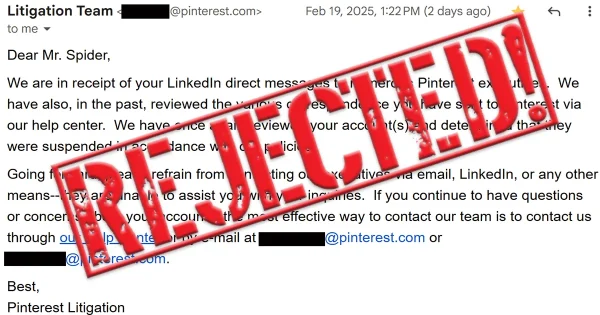
Their response came from Litigation Team/Pinterest Litigation
February 19th, 2025
Subject: Pinterest Reporting Channels
Dear Mr. Spider,
We are in receipt of your LinkedIn direct messages to numerous Pinterest executives. We have also, in the past, reviewed the various correspondence you have sent to Pinterest via our help center. We have once again reviewed your account(s) and determined that they were suspended in accordance with our policies.
Going forward, please refrain from contacting our executives via email, LinkedIn, or any other means–they are unable to assist you with your inquiries. If you continue to have questions or concerns about your accounts, the most effective way to contact our team is to contact us through our Help Center or by e-mail at email redacted or email redacted.
Best,
Pinterest Litigation
That was not written by a lawyer
Was I supposed to think this was someone with a legal background?
A friend of mine insists that before I talk about what is wrong with this email, her notes be posted first. And while Pinterest does not scare me, she does. So, to avoid her stares of disappointment (daggers to my soul), here are her notes:
- Basic Format Problems
- No proper subject line for a legal communication
- Generic signature (“Pinterest Litigation”) instead of a named person
- Casual closing (“Best,”) in what’s trying to be a legal letter
- No case/reference numbers
- Missing standard legal disclaimers
- Writing Issues
- “We are in receipt of” (overly formal, just say “We received”)
- “the various correspondence” (incorrect grammar – correspondence is uncountable)
- Inconsistent spacing after periods
- Uses dashes instead of proper em-dashes
- Mixes formal and casual language randomly
- Vague/Poor Word Choices
- “numerous Pinterest executives” (not specific)
- “your account(s)” (ambiguous – which accounts?)
- “any other means” (too broad)
- “unable to assist” (weak phrasing)
- “questions or concerns” (sounds like customer service, not legal)
- Confusing Directives
- Mixes trademark and copyright contacts without explanation
- Doesn’t specify a preferred contact method
- Unclear what “most effective way” means in this context
Wow, that was pretty bad
First things first, I never emailed any of the executives. If I had their (work) email addresses, that would have been my first channel to pursue. Instead, my outreach was strictly through LinkedIn. The fact that Pinterest’s Litigation Team stated otherwise raises a question, did they even verify their own claims before sending their response, or did they just assume and hope I wouldn’t correct them?
Notably, Pinterest CEO Bill Ready deleted my comment. Plus, Pinterest General Counsel Michele C. Lee blocked me and deleted my comment, which I believe is problematic.
What is most notable is they only addressed my suspensions. Not the rest of my concerns, which means they did not review anything I sent before this. Keep in mind I only told Bill Watkins, Michele C. Lee, and Wanji Walcott about my suspensions. (Edit as of 4/4/2025, I realize now I never told Paul Rockwell . Not a single domain from any of the spam networks I mentioned was blocked. Which makes it abundantly clear they did not confirm if my accounts had actually violated policy. Everything I wanted to share can be found within my claims and other correspondence. I never held anything back. I have repeatedly offered to provide the details again, and still would. I am interested in protecting users on their platform even if they are not.
They reviewed nothing, having referenced nothing more than my correspondence, most of which at best received an automated message stating it would be reviewed or forwarded, only to never get a response. That is the channel of communication they wanted me to return to, which is effective at grinding down innocent parties.
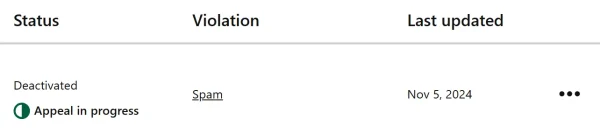
Another reason I know no one has looked can be found just by attempting to login. From the metadata, Pinterest will see that was shortly before this was published. But at this point, I would not be surprised if they change the status of my appeal. Never mind all the emails I sent them with similar screenshots.
Pinterest’s decision to respond from the “Litigation Team” / “Pinterest Litigation” rather than a consumer outreach department was a calculated move to intimidate me. By using a faceless entity instead of a named attorney, they hoped to avoid accountability while subtly implying that legal action could be on the table, without actually making any claims that would require them to follow through. If this were a real legal matter, they would have issued a formal cease-and-desist or cited specific policies and violations. Instead, this was a strategic attempt to discourage further contact, establish a power dynamic, and make me feel pressured to drop my concerns, without having to address any of them.
This is weak sauce compared to the many threats I have faced in life. It was bad legal letters like this that got me back into blogging, which you can thank Copytrack for. Manashosting, if you ever read this, Pinterest stole your spot, or maybe it was Mindshark.
They can no longer claim ignorance after I contacted them.. they know, and they know I know
They just want me to go away, they got everything that they wanted from me
The destruction of my livelihood is nothing to them.
Notably, Pinterest never supplies evidence for what led to my accounts being suspended, claiming policy prevents that. Perhaps I cannot find that policy due to the policy not being available to the public. I did as they asked in addressing concerns for my accounts and contacted them through what they consider proper channels, and I am not expecting an answer to:
Please provide a direct citation and indicate where on Pinterest this policy can be reviewed, which explicitly states that Pinterest is prohibited from disclosing the specific violation.
While I am fully versed in what constitutes a policy violation and have observed Pinterest’s failure to consistently enforce those policies, I am struggling to find the policy in question that Pinterest relies on to justify withholding proof of an infraction. Transparency in enforcement is vital, not only for due process but also for addressing perceived violations in a meaningful way.
I am not a person who likes to be the center of attention, and yet I now have to navigate exposing bad actors that might target me if I get their accounts shut down. They could dispute my copyright claims, Pinterest will not consider the spam violations committed by those accounts and will just give them my address. Never mind I am still scrambling to recover from Pinterest’s actions.
I would have loved to work with them. I was invested in Pinterest beyond just ad dollars, my brands were intertwined with their platform. I had recommended people to use Pinterest. Now, I feel like a fool for doing so, which means I need to explain to them why they should not consider Pinterest. So as I formulate how to save face with my friends over recommending them to Pinterest, let’s discuss how Pinterest deletes evidence.
I made it explicitly clear that I document everything, and they still thought they could quietly erase my comment, which is evidence, like it never happened. Again, I have receipts. After my engagement in January (likely the next article), it was clear documentation was not just precautionary, it was essential. Which they would have known if they had actually reviewed my engagement that month, where I outlined clear evidence that Pinterest had failed to enforce its own policies ..twice involving malware.
I submitted evidence three separate times, only to receive this canned response:
“Hi there,
Thank you for bringing this to our attention.
We’ll review your report to determine if it violates our community guidelines. For more details on what Pinterest defines as spam, you can review our policies.
If you need further assistance, don’t hesitate to reach out through our Help Center.
Thanks.”
After that? They quietly deleted my submission without a single notification of any actions taken. When they did, I contacted them, notifying them I was aware of their undocumented deletion.
All of the accounts provided as evidence were directly involved in copyright and trademark violations affecting my brand… meaning I should have been updated as the rights holder. Yet, Pinterest quietly removed the accounts in my evidence. Yet, again, none of the domains involved were blocked.
That first time made it crystal clear I needed to record evidence before submitting it. Never mind that I already had linking directly to a YouTube video documenting everything. But when I went back to re-record, I realized the account had been wiped. After the third time, it was clear Pinterest would only act if i laid out how they failed to act on policy violations.
Here is the video I sent them as proof the first time that they did not act on clear threats: https://youtu.be/SQ4nGKp7ekk
And it wasn’t removed for clear user safety, policy violations, or copyright theft. No, that content stayed. It was only erased when I presented it as proof that Pinterest refuses to enforce its policies against actual violators.
I am officially done with Pinterest
So much for the claims of being a stable platform.
Now I know there is no reasoning with Pinterest, and there is certainly no reason to contact their executives
I wanted to respond to their email with something sarcastic mirroring the responses I get after appealing my account suspensions in regards to their request. But I changed my mind, however I want to share it anyway. While I see no valid reason to reaching out to the executive, even when I wrote this, I just wanted the chance once to deny their requests.
I’ve considered your request and decided to humbly decline it.
Please review the rest of this email… along with your own Community Guidelines on what Pinterest considers spam.
If you have further questions, you can reach me at this email rather than the black hole that is your Help Center. I’d be happy to tutor you on what constitutes spam.
Instead of sending that, I moved what was going to be in that email to this blog post. Then, I sent them an email that clearly outlined that I never emailed any executive. That I would have settled for being heard and having my accounts restored. But now, it is undeniable the last 4 months of my life were wasted trying to appeal to the unreasonable. So now, I take the legal, ethical, and weird route.
I know I said Blogspot was going to be my next article, which is a complicated mess to sort out as I see patterns in the chaos. But the next post will be about two sites I reported to Pinterest that had malware. This particular post has split off into nine different drafts (like what happened with Copytrack), such as How Pinterest Convinced Me to Give Them $80,000, Their deletion of evidence…).
I wanted to cover it all in one post, but it takes time, and you see how long the response to their email is.
But, I will include the timeline that lead to my suspension:
October 26, 2024 – Filed 236 DMCA Takedown Requests
I submitted DMCA claims against 244 images takedown requests for substantial copyright violations, including:
- 10 images with Blogspot URLs
- 98 images with URLs leading to a Medium(.com) fraudulent donation page. Despite account removals, I keep finding orphaned pins linking to these URLs.
- 136 images tied to a spam network of 15 accounts promoting content across six domains:
- blizzypanda[.com]
- boredpanda[.com]
- juststarz[.com]
- rightlivin[.com]
- romanticfeed[.com]
- scientistplus[.com]
Notably, none of these domains were suspended despite multiple claims.
October 28, 2024 – Uncharacteristic Copyright Response from Pinterest
Pinterest responded with two vague Copyright Request numbers, instructing me to use the Help Center. This was an unusual deviation from previous DMCA claim handling, making tracking and enforcement significantly more difficult.
October 30, 2024 – DMCA Claims Routed to ‘Community Guidelines’ Review
Pinterest notified me that my DMCA copyright claims would be reviewed under “Community Guidelines” instead of standard copyright law.
- This was not how my previous DMCA claims had been handled, raising questions about whether my claims were receiving proper legal enforcement.
- This alternative review process was not clearly explained.
November 1, 2024 – Pinterest Suspended My Accounts Without Explanation
Pinterest suspended my accounts for alleged ‘spam violations’ without:
– Any prior warnings.
– Any specific explanation.
– Any evidence of ‘spam activity’ associated with my accounts.
- Despite multiple requests for clarification, Pinterest has not cited a single example of spam behavior.
- Given that my suspension occurred days after filing large-scale DMCA claims, the timing is notable.
Note: That policy of nondisclosure is internal, not public.
November 9, 2024 – Sent Certified Letter to Pinterest’s Legal Department
After Pinterest failed to clarify the reason for my suspension, I sent a certified legal notice requesting:
November 18, 2024 – Certified Letter to Pinterest’s Legal Department Received
November 26, 2024 – Delayed & Irregular Processing of My DMCA Claims
After my certified letter, Pinterest finally confirmed receipt of my October 26 DMCA claims. However:
- My October 26 claims were not processed in order.
- Instead, they were bundled with DMCA claims I had filed between November 1 and November 19.
- These 244 claims were consolidated into six Copyright Infringement Report numbers, some of which had already been resolved.
- This bundling made it difficult to track individual cases, raising concerns about whether all violations were properly reviewed. (notably many of the accounts remained active)
The timing, arriving shortly after my certified letter suggests a reactive response rather than routine enforcement.
To all that read this, thank you for your time. (Not you Pinterest)
One more thing Pinterest…
If I truly wanted to spam, the last thing I would want is attention and yet here I am, begging for it. I certainly wouldn’t have spent $80,000 on ads just to watch that investment go up in smoke. I wouldn’t have wasted time on appeals that go nowhere, and I definitely wouldn’t have a few accounts I’d have thousands, watching Pinterest only pick off a few while the rest keep running and building on those accounts everyday. At this point, I could teach a masterclass on evading Pinterest’s policies and I’d do a better job than the bad actors I see thriving on your platform.
But like a fool, I took the honest route. I mistakenly believed Pinterest was an honest actor when I started advertising. I am not angry, but I am exhausted and very disappointed. How many good people has Pinterest exhausted to the point of no return?
I hope you get the message… Because I Won’t Back Down. So much more to come.
How many good people has Pinterest exhausted to the point of no return? Leave a comment.