
Since I started reviewing complaints against Copytrack.com, most were on behalf of WENN Rights International Ltd; after them, it is Federico Caputo. A name I started to see more frequently as I dove into complaints online. Had I had a better ability to focus on a topic, this would have been out in late May. Still, I got sidetracked when I found someone who foolishly brought attention to a legitimate copyright claim against them by responding to tweets that were part of the discussion of this piece, so I found out what he stole,
In those tweets were two images Copytrack claimed to have successfully won in court. Both of these belong to Federico Caputo and can be purchased at Adobe and other sites. But before I get into this further:
I do not encourage harassment. If you are going to reach out to him, please be civil. So far, unlike Wenn Rights International LTD, I don’t see many false claims of ownership. But in most cases, I have seen the person the claim was sent against have rights to the image or may have misunderstood how they acquired their license.
If you need advice on dealing with Copytrack, check out my guide on how to Respond to Copytrack.
So, to start, I want to focus on what could help address his claims—unless you stole the image(s). If you did, I think you will find out why you can offer Copytrack a substantially lower payment on Federico’s work while skipping the renewal fee.
Was the image(s) you got from Adobe free?
Instructions for finding your licenses with Adobe Stock
Adobe offers a 30-day free trial to get 10 images. While other stock image sites also offer his images in their trial, Adobe is the only one I see complaints and confusion in terms of Copytrack.com disputes from Federico Caputo, which is why I want to focus on Adobe. I believe that most of the claims Copytrack.com has sent out for Federico Caputo are the results of a free trial, as most claims (so far) referenced Adobe. Some thought they got it from Adobe’s free stock library. Some, I believe, did not keep track of their stock image licenses, not knowing how to retrieve them later. So, I want to share instructions on where to find the license(s) and what details to give Copytrack.com and similar companies to avoid an absurd bill. This should work on other claims for images acquired through Adobe through other creators. However, this only works if you have login details to the Adobe account through which you acquired the images through the trial process or bought them. If you remember your account details but don’t have access to the email account associated with the account, you may want to contact Adobe to recover your account.
Steps to find your license(s):
- From a browser, Login to https://stock.adobe.com/
- Click on your profile picture. Located in the top right-hand corner.
- Next, click on License History.

From there, you need to collect the following information:
- Date
- Author
- Asset ID
- License Type (likely standard)
- They might also want to get the image’s name, which can be retrieved by clicking on the Asset ID.
With that information, you should also give them:
- Your account ID (likely your email address)
- Name/Company the account is under.
- A screenshot of where the image appears in your license history.
That should get them off your back, but if you want to be difficult, ask them for proof of ownership. State you want to make sure you are dealing with the actual rights holder.
I am confident you will be able to get this information if you have access to your account and acquire it directly from Adobe. It does not appear they delete the licenses after the subscription is canceled, as this was from the email I got:
We’ve processed your cancellation request. Your Adobe Stock subscription will end on 30-June-2024 (PT). As a reminder, you’ll lose access to all your unused Adobe Stock downloads after your subscription ends. You may continue to use assets you’ve already licensed.
I canceled the plan because I don’t use stock images from Adobe and will not use the ones I got while recording/documenting my experience. I believe in paying for the work I use.
Note: The plan would have been renewed at the end of my trial for $29.99 a month. While I recorded my cancelation, I found out that after you cancel, they will offer it to you for $19.99 a month for the first year.
Now, onto those who do not have licenses for Federico Caputo’s work
To start with, I am not a lawyer, so keep in mind that this is not legal advice. I hope that this part will help avoid the necessity of a lawyer. Avoid those who claim they can make a fair use argument without knowing the circumstances, like one whose SEO targets keywords that involve Copyrack. So my intention is to show how his images are far cheaper then Copytrack the fees they want. No, that does not mean buying the license. That means finding out the value of the image and arguing them down.
*This space is to be updated soon with a link to a draft for responding to Copytrack*
I kind of wish to avoid helping thieves, but I have encountered too often someone who hired a web designer but did not hand over the copyright afterward, only to be hard to contact later. So, this is for them. But then again, I don’t think penalties should be unreasonable.
The next part of this article deals with the claims Copytrack.com sends out, the process clients go through to file a claim, and how much they actually cost to obtain. I think you can use this information to argue for lower licensing minus the yearly fee since there is no recurring fee per image with Adobe and other stock media sites.
Please note: Buying the license afterward will not work to get them off your back.
Now, back to Copytrack and Federico Caputo.
Copytrack has filed two successful lawsuits on behalf of Federico Caputo
In this lawsuit, they won €900/$973
 ]
]
In this lawsuit, they won €1800/$1945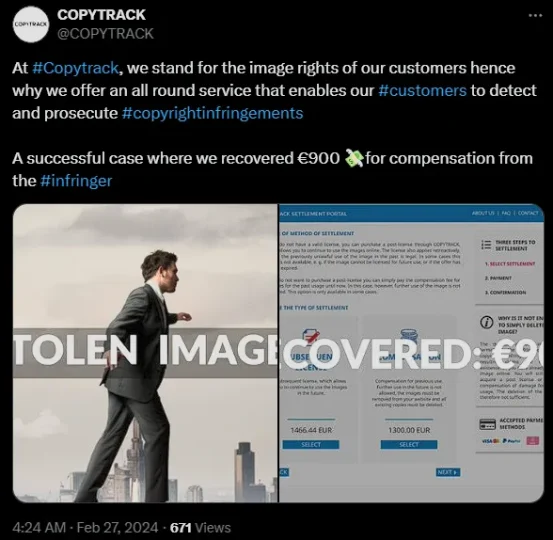
A whopping €2700 / $2919 for images that could be acquired through a free trial for nothing to… well, let’s say €28.32 / $30.60… because maybe you don’t feel like using someone’s work without paying them, as I stated earlier. So you can just post them to your website like this…


I positively identified him as the owner through Tineye on reported images that could be bought at Adobe and Shutterstock.com under Alphaspirit. On Alamy.com, with the ‘gears’ image, it is under the account Federico Caputo
As a side note, on Shutterstock.com, I purchased a two-image credit plan instead of a subscription. However, that plan billed my card again when I used my two credits. When I got to the second image, there was a notice that stated my credits were running out and how I could add more. Automatically charging my card for two credits is not a good deal when I could have gone with their subscription plan and got those images for far less or gone under a trial and got them for free. Those credits must be used within a year, which is another reason I do not agree with them automatically billing my card when I have exhausted my credits. They refunded me after I contacted them.
Federico Caputo’s relationship with stock image sites and Copytrack.com
On the one hand, he sells images on stock media sites at rather low prices; on the other hand, he runs those same images through Copytrack.com to file vastly inflated values in his claims. He is not the first to do this, especially with a vast catalog. I get why one wants to make a copyright thief pay through the nose, especially as someone who has constantly had that battle. You put all the work in, and someone benefits from your work with as little effort as copy and paste. Often, they get better results with the same content (which often happens to me on Facebook). I truly get the desire for payback.
I wish I could see more details about these two cases Copytrack filed on behalf of Federico Caputo, as I have questions.
- Were the images intentionally stolen?
- Did the attorneys and court know these images could be acquired for as little as $3 under a subscription/free under a trial?
- Were these images commercially successful for the defendants? In most cases, I don’t see traffic metrics that validate the costs of what Copytrack tries to claim.
- What country was this in? I think it was likely in my country, the U.S.
- Did the defendants ignore Copytrack?
- Did the defendants in these cases seek legal counsel or let this go to a default judgment?
Keep in mind that Copytrack clients can choose how much they get paid, up to €1000. Likely Federico Caputo, or more likely someone who works for him (as screening on Copytrack is time-consuming), picked the upper limit or what the highest amount they could demonstrate getting for an image. I have not seen if they also choose how much it costs to use each year or if Copytrack estimates that off what the client picks for reimbursement. The annual fees so far have been between €300 – €900; on an image, you pay for once on other sites. Oddly, reoccurring use is more expensive than past use, which is often listed for years of use. But, the client gets 55%.
Monitoring up to 500 pictures with our highest-accuracy image finder is free. And our enforcement services are always free for you – we only receive a commission if you get paid.
You keep 55% of any compensation or post-licensing fees and we have you covered for all legal steps we might take on your behalf.
Of course, billing is completely automatic to save you valuable time. You never have to pay in advance. – Copytrack.com
I wonder how Federico Caputo proves a sales history to validate his claims when the images can be cheaply obtained. This is the wording in the two claims they sent me for the same image they did not represent.
We calculate these fees based on our client’s license history, as well as the duration of use and type of rights infringement. Failure to provide a proof or pay for a valid license may result in your case being referred to our partner attorney and significantly higher additional fees.
I did ask for proof, but now that I think about it, I should have asked for the sales/license history
Another client of Copytrack posted this in their review of the program:
In theory, we’ve submitted claims for as high as 1,000 Euro and hope for the best. But in practice we’ve had Copytrack come back asking to settle for less (in countries where it would make sense financially) or that we’re asking too much (since we do not have proof of selling the image for that rate previously).
In other cases the maximum we could ask for is significantly lower, and we have no real understanding of why the cap varies so much from image to image.
So, suffice it to say, putting in a claim on Copytrack is more or less asking for the full amount and getting whatever you can- it likely isn’t going to be anywhere near your initial submission unless you have a sales history to back it up. – Jermey of thisweekinblogging.com – https://thisweekinblogging.com/copytrack-review/
So far, I think most of the image claims filed by Copytrack would fall under a standard license, not an extended or enhanced license. I would be interested to see what evidence was provided to justify asking for such an absorbent amount. Perhaps Federico Caputo or someone working for him provided proof from extended/enhanced licenses, but the usage I have seen does not seem to warrant what Copytrack demands.
Federico Caputo has the numbers that Copytrack loves
Like other stock image sites, Adobe has a trial program that allows you to download up to 10 of Federico Caputo’s images. Meanwhile, Copytrack is looking for those images.
- 10,000 on Adobe. (an estimate I came up with after counting the total images on the first page, 100, and then multiplying by the number of pages, 100)
- 22,921 on Shutterstock
- 14,506 on Almany.com
- 23,443 on 123RF
I have no idea what the amount is on other stock image sites, but I can only assume it’s in the tens of thousands. If you look at the image of the man on the rope from the one they claimed to have won €1800, it differs from the one I bought off Shutterstock (different backgrounds, but same man on rope), which is not available on Adobe. So, I do not know the total number of images circulating. The ‘gears’ image can be found on Adobe, Shutterstock, and Alamy.
Federico Caputo uses AI to create Stock Images.
Some people think I am against AI use in art, but my feelings are complex when discussing it. Ultimately, it boils down to how much work a person does and how much AI is involved. Typing in, you want to see a dancing cat as the extent of your work, which is having the AI do all the work. I question the value and uses of this kind of creation. For now, the US law does not consider it copyrightable.
“When an AI technology determines the expressive elements of its output, the generated material is not the product of human authorship. As a result, that material is not protected by copyright and must be disclaimed in a registration application.” – United States Copyright Office
However, it is a different story when used as a tool aiding in the creation process.
““This policy does not mean that technological tools cannot be part of the creative process. Authors have long used such tools to create their works or to recast, transform, or adapt their expressive authorship. “- United States Copyright Office
For my and Copytrack.com’s thoughts on AI Rendered Art – Click Here
Based on a glance at the stock library on Adobed, I have no idea how many AI-generated images Federico Caputo’s catalog has. Adobe does have several that I browsed through that are marked as AI-generated, but it does not mention anything about human input.

When I started writing this article, I thought he had not added much content in the last few years because I saw COVID-related images on the first page of the results. However, either Adobe randomizes images shown in his catalog, or he has restarted adding images. Yesterday, I saw one that questioned whether it could be copyrighted, not because it was AI-generated, but because it just says “50% off” in white letters on a red background—a short basic design with a common phrase lacking creative expression. I wonder if Copytrack.com is searching for this image because it will lead to many false positives.
To be clear, I don’t have an issue with AI, even in art, unless it uses someone else’s art to model without their permission. That is perfectly fine if it was modeled on his own works or those who willingly allowed their art to be used to train a model. Selling that work? Sure, why not? But that poses the question of copyright eligibility. Such works require mostly human influence to obtain copyright status in the U.S. While I have openly wondered how much Copytrack has taken concerning works they do not represent, I also wonder how many works were mostly, if not all, AI-influenced, in the cases Copytrack.com pursued.
My question about AI leads to concerns beyond Copytrack’s harassment of people, such as how much the attorneys and courts involved knew about the process of creating these images. I have doubts that anyone asked about the creation process when pursuing fines.
Copytrack.com’s service is inefficient
This triad between Copytrack, Federico, and the stock image sites is troubling. Copytrack cares nothing for efficiency. They want their clients to process claims and add more images to the search. Once clients stop filing claims for too long (6 months), their account is closed. At the same time, false positives are all too common, devouring time as a rare commodity. Never mind that claim from Copytrack.com that one of the advantages of using their service is ‘saves precious time’.
I don’t believe Copytrack.com should be involved with images on major stock media sites. However, their business model is one designed based on what gets the most hits: quantity over quality. I think stock media sites should enforce copyright, which I realize could be complicated by some of the same images sold on multiple sites for Federico Caputo. However, perhaps that could be solved by stock media sites having a licensing system that lets organizations like Copytrack know what sites have what images; website tracking is not part of any stock media site I see. This would reduce false positives that lead to unnecessary drama. AI could integrate with the stock and media sites, looking for stolen images without the limits of Coptrack’s com 500 free images. Adobe, Shutterstock, Almany, and others already have the images and who created them. Federico Caputo and WENN Rights International Ltd have their images on their own site, and I assume they integrate through Copytrack’s API… unless they are paying extra to host their images.
I don’t like the idea of buying an image only to have to prove I did it at some random point in time. It would certainly make me rethink buying from the site I got the image from.
Adobe is not perfect
I wanted to add my complaints about Adobe, but after two months, this needs to come out of the draft, or it might eventually become irrelevant. This happened with too many articles I was working on at Hosting-reviews-exposed.com, where I deleted over 40 drafts. So, that is a post for another day.
Federico Caputo and Copytrack.com
Finale Thoughts
I hope my instructions helped you find licenses with Adobe. If you have to pay for Federico Caputo’s images, I think there’s a strong argument for lower fees, given how much cheaper the images are on stock image sites. Definitely request the ‘client’s license history’.
In my next article, I’ll cover Copytrack’s history of pursuing images it doesn’t represent. After that, I have an article that ties into everything I have worked on. Then, it will likely be a while before I cover Copytrack as there are only a few other topics I can think of I want to work on. I will still collect claims from Copytrack – Click Here to Share yours Maybe one day, I’ll see if Copytrack has pursued AI-rendered art.
Thank you for reading. Have a wonderful day.