At some point, I will try to do a deeper dive into fair use and what it is not. This post will focus on one complaint with Copytrack.com on Twitter by Franco L Maglio. While my interest in Copytrack is their false claims, I can not ignore that they can also find legitimate copyright theft. But I question if they represent the copyright holder. It is hard not to conclude they may have gotten paid in cases where they did not represent the copyright holder of an image. Most complaints against Copytrack.com revolve around false claims, from trying to claim public domain images, media release images, self-made images… I could keep going.
Most of the complaints revolved around Wenn Rights International, a paparazzi site with millions of images. However, as I collect complaints, the second biggest name on that list is Federico Caputo, who has over ten thousand images sold on stock image sites like Adobe. The sheer volume of images, I believe, leads to a massive number of hits by Copytrack’s system. Hits are sent off to be screened before Copytrack pursues a claim. The screening process is where I believe the problem lies. Because I rarely see complaints against those lacking a massive library of images. Regular users complain about the sheer volume of images they must go through. How do those with the massive libraries do it? I assume a third party handles it due to the unending number of false positives that must be shifted through.
Despite all of the complaints about being a copy troll, Copytrack does have legitimate claims. In this post, I address what I believe is one of them, so my focus for this post is more on an individual than Copytrack. I had no intention of pointing out copyright theft because there has been no real monetization in 99% of the cases I see. Profit is often a metric in copyright lawsuits, so I simply ask them to remove the content. A lawyer will likely want to know how much profit was made off the theft. Keep in mind, they are in it for the payday. Something I will get into in the next post. Most will oblige to my requests to remove my content; rarely do they not comply, in which case I take other steps to remove my content, none of which involves a lawyer acting on the terms of service of where someone might have published my copyright.
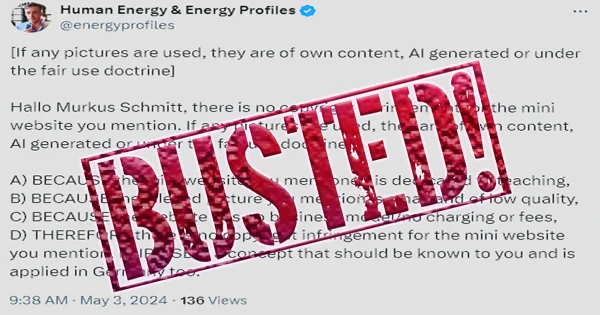
While working on another post and video in regards to the second biggest name in complaints and Copytrack’s lawsuits, I saw Franco L Maglio’s comments on a Copytrack tweet:

I found this claim while examining one of Copytrack’s victories. I was interested in the claim Copytrack sent him to see if they represent the rights holder (I think they did). But I think it is more important to address his Tweet. Most who confront Copytrack publicly have valid claims, like Ruth Wong, whose husband took pictures of her. Copytrack wanted around 400 euros for her pictures. I will spare you the rundown of the other claims that all provided evidence. She had a valid argument, but Franco L Maglio, the owner of OUTLK, does not even provide evidence.
While the content you create is generally yours, the rest of that statement is another matter. I wanted to respond directly to him. As I wrote a response, I had hoped to keep it down to one tweet. But as I looked through his site and Twitter feed, my responses grew from one tweet to two, then three… and at 5, I stopped and decided to make this post and a video. But, I only intended to make a short post, and yet this will not be a short post as I pull back the layers of this onion called OUTLK by Franco L Maglio because this is about more than just a misunderstanding of fair use. I believe Copytrack is right about theft and their pursuit in this matter. This is why I posted nothing after I made my comeback post.
First, I want to address this part of the tweet:
[If any pictures are used, they are of own content, AI generated or under the fair use doctrine]
I recommend watching Legal Eagle’s video regarding AI art. AI does not mean being consequence-free, especially from platforms that use other people’s work to train their AI models. I am sure we will eventually see the courts grapple with that question.
Now, onto his three points. (yes, I said three, not four)
A) BECAUSE the mini website you mentioned is dedicated to teaching,
If you read Franco L Maglio’s site and/or watch his video (I regret doing so), the term used for visitors to the site is clients, not students. But regarding mini, I believe this is a funnel entry page/lead capture page intended to lead to the sale of other services.
Our Reach: OUTLK is trusted by diverse B2B clients across China, India, Europe, Canada, and the U.S. As the world embraces new management techniques, blending Eastern philosophies with Western practices, we’re proud to lead the charge.
Based on this wording, I believe something is beyond the signup page. OUTLK appears to operate as a business that provides personalized compatibility reports based on ‘metaphysical concepts’ of “energetic timelines.” These assessments are supposedly used for team building and personal analysis rather than scientifically validated educational content. The part about the 5 countries could be a lie, a lie that does not help with the claim of being small.
Looking at Archive.org, I can tell you the site was not always a single page. Before April 2024, there were celebrity profiles, which may be where the copyright claims may lie. Because many of the images were scraped off various stock image sites and individuals. There is one image I think is valid for him to use freely, the one of Speaker Mike Johnson because it is likely in the public domain. However, one image sticks out, and I used Tineye to confirm it was indeed a stock image found on Shutterstock, Adobe, and other stock image sites. It used to be more prominent behind the first video, but it is now less prominent. If this is the image in question, getting out of a claim with Copytrack will not work. A claim of fair use will not work since there is no demonstrable fair use in being a background image. I believe this change was a result of Copytrack’s claim. Also, hiding the rest of the site by not linking it to the main page will not always prevent stolen images from being found. …but that is not the image I think the copyright claim was filed against. Nor do I think this is the only image he does not have rights to.
B) BECAUSE the alleged picture you mention is small and of low quality,
Claiming a small/low-quality copy of an image(s) is insufficient justification. This statement lacks any understanding of copyright or fair use. Such alterations are frequently made to circumvent infringement claims, which are not effective, which, I think, is the case here. Nor will removing it.
C) BECAUSE the website has no business model/no charging or fees,
This last point inspired me to write this post. As I looked through the site to validate his claims, it was clear that his tweet and site told two different stories. Note that there is no clear indication of who is free. The Parties of 5 or 10 (A typo to fix.) are free.
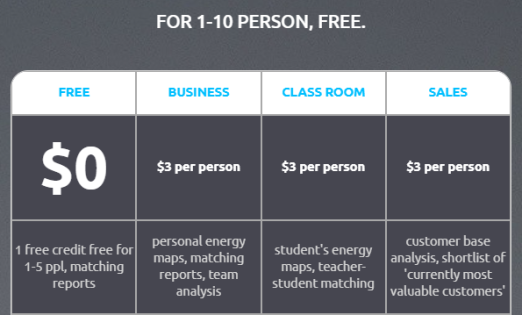
The claim that there is no business model is, in my opinion, false. While the site does not out and out say what the business model is, I am certain that the report generated is only the first step.
Getting Started Is Easy: All we need is your birthday and birthplace. With this minimal information, we can generate a detailed compatibility report, delivered straight to your inbox within 1-2 days. For smaller teams, we offer this service free of charge. For larger groups, our rates are straightforward: just $3 per person. So, a company with 500 staff can receive a comprehensive analysis for just $1,500.
What happens after the ‘compatibility report’ is not clear. But, like free food samples, the intent is to get you to buy more.
D) THEREFORE there is no copyright infringement for the mini website .
This is not a point but a conclusion based on the three points. There is no proof of fair use. As I suspect, the site was altered to hide proof of theft. Fair Use/Educational purposes require that the subject be related to the image; given the nature of this business, it’s a stretch that any image they might use would meet those criteria. It would be like using a picture of Captain America while discussing how ginseng was introduced to the Western market. The site is (now) purely a signup page for something not at the front of the site (which is a subdomain).
If it were not for his three points, I would probably have contacted him and asked for more details. But I feel there is more to examine than a simple copyright claim.
This compatibility report raises a few curious questions:
- What percentage of compatibility reports generated by visitors to his ‘mini website’ have concerning lows in the future?
- What percentage of ‘clients’ are already experiencing a difficult period in their lives when they seek out these services?
- How long are ‘clients’ dependent on services beyond the initial compatibility report?
- Are there solutions to those low pecks, and what are they?
Here is what I assume the answer to those questions is:
- All: I believe all compatibility reports generated have concerning lows predicted for the future.
- Most: Most clients are likely already experiencing a difficult period in their lives when they seek out these services.
- Duration of Dependency: Clients might continue to use the services until either Franco finds it no longer profitable or the clients themselves realize they are not achieving the results promised in terms of relationships, success, and other benefits mentioned from the use of these reports.
- Monetization Beyond Initial Report: While the specifics of subsequent offerings are unclear, it’s reasonable to assume that Franco likely has further monetization strategies planned after the initial compatibility report.
The site reminds me of many MLMs that don’t show everything upfront. After you see their presentations, they try to get you to buy information and other so-called tools for success. That free report is supposed to show a graph of peaks and lows representing a person’s life.
The details used in the reports make me think of the so-called psychic John Edwards. Both offer a seemingly personalized experience. Edward might mention a common detail, such as a father’s name starting with ‘M’, to create a personal connection as he fishes out a mark. His tactic relies on those who have lost loved ones due to the psychological impact. Franco L Maglio’s OUTLK tactic relies on those seeing the negatives in his compatibility reports, but the better target for him is those already experiencing real-life problems. Outlk might be able to make a past timeline that looks relevant based on information, such as name, birth date, and birthplace, that you would have to provide. Three details I would not give out to an unknown site.
But back to those details. Unless you are famous, people generally do not know your place of birth or your birthday. Combine those with your name, and he might very well be able to look up details to make the report look real, which is why he likes to do videos on celebrities. Take, for example, Scott Adams, the creator of the Dibert comic. Franco points to publicly known details about Adam’s educational history.
I decided to take a deeper dive into what Archive.org could show, and that is when I think I found the image Copytack.com confronted Franco L Maglio over.
So, it turns out Franco L Maglio stole a Tailor Swift image from… *imagine there is a drum roll going on* …Wenn Rights International!!! I congratulate him on being the first truly valid claim I have seen Copytrack pursue for Wenn Rights International Inc. Because I have seen nearly 200, and not one until now was valid. Despite the changes on the site, it will not matter. Deletion does not equal removing the evidence. Keeping your site off Archive.org- The Way Back Machine will not help either.
I would not have covered this claim in such detail if not for the audacity of the claims for an image being used; it certainly did not help with the nature of the business presented. To anyone interested in a compatibility report, I suggest a good measure of skepticism before opening your funds to a snake oil salesman. I doubt Franco L Maglio is doing this out of the goodness of his heart or that he has an AI. From what I have seen in the videos, he uses vague terms such as “energy timelines” and “vibe detective” without explaining how the process works. I haven’t even addressed the weird matchmaking he tries to do. But, should I see him become a problem, I will return to this subject.
I am sure that after I post this, I will not see the Copytrack claim, as I decided not to contact Franco. Partly because as I end this, I realize I need to exercise caution regarding how much exposure I give his site. However, I am reminded of a site called Mindshark.ca. They decided to spam my email, and when I confronted them, they claimed I opted in. This was a so-called SEO company, and my friends taught me enough to dominate the search engine results. Eventually, I took the top spot from their site, which is not a good thing to happen to anyone calling themselves an SEO expert.
I will be keeping an eye on this operation.