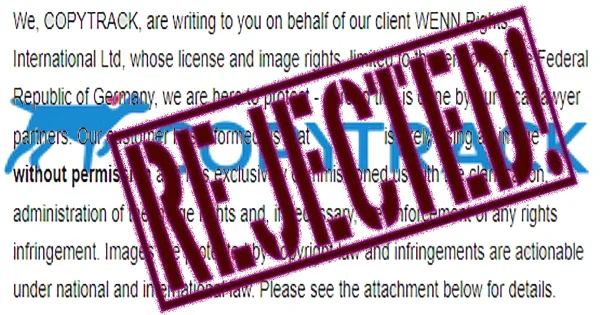
So, you found this piece while learning how to deal with Copytrack.com. I don’t think I will offer the ultimate solution, but it will certainly throw a wrench in their works. The focus is on making sure you send the right response the first time, though it is likely you already responded. In this case, I still suggest one of the drafts below crafted for four different scenarios. You are the owner, you have rights, no rights, and the image(s) is AI Rendered (requests proof of mostly human influence).
For those who ask, yes, Copytrack is a legitimate company, not a scam. However, they are as legitimate as Oreo (or whatever junk food is common in your region) is food. They are just effective as a copyright enforcement solution in the same way Oreo is at providing nutrition.
Disclaimer: Before you proceed, I am not a lawyer, so this is not legal advice. While I have not tried any of the drafts, I feel these are reasonable requests to send to Copytrack. So, you might be able to resolve this without a lawyer, and hopefully, fees will be lower for those with no rights to the images if Copytrack does represent the rights holder.
But before you go for the drafts I prepared, I want to break down a few things. I was inspired to write this, as well as five other articles, as I worked on a piece about a Copytrack client that sells its images on Adobe. All of these articles are linked to various parts of this piece.
Copytrack has no problem with you contacting their clients for answers
As I write this and another post that may be my last on the subject of Copytrack, I finally got a response saying all claims were closed without explanation. I got a second response after I pressed for answers on July 23, 2024.
Dear Sir or Madam,
Thank you for your recent correspondence.
Copytrack, acting on behalf of our client Wenn International Agency, initiated contact with you in response to the alleged unauthorized usage of an image owned by our client. Following your response, where you asserted proper permission for the image usage, we have duly noted and closed the case.
It is important to clarify that Copytrack’s role is limited to facilitating communication related to copyright infringement matters or issues pertaining to Wenn International Agency. Any further correspondence or queries concerning the Wenn agency should be directed to them directly.
We appreciate your cooperation in this matter.
Best regards,
Zara
Legal Department
COPYTRACK GmbH
In my next post, I plan to discuss how that response does not make sense. But they certainly have no issues with me contacting Wenn regarding Copytrack’s enforcement, which I did. I feel this email opens the floodgates to contacting their clients directly. Contacting their client as you respond to Copytrack with the solutions I provide below may allow you to close the case faster or negotiate for better terms. If you do, please be civil and not make threats.
Copytrack.com claims to have records
…but do they?- But first, a list of things not to do.
So, here is what I do not recommend, based on a lot of bad advice I have seen in the process of researching Copuytrack:
- Ignoring Demands: Ignoring legitimate copyright claims can lead to legal consequences, including lawsuits. Failing to respond might escalate the situation and weaken your position if it goes to court.
- Claim Fair Use (when it is not fair use): Fair use is a complex legal defense that depends on several factors, including the purpose, nature, amount, and effect of the use on the market. Misapplying fair use can lead to losing the case and incurring significant penalties. For an example of a bad faith fair use argument. read my piece on Franco L Maglio.
- Deleting the Image (and blocking archive.org) is called destroying evidence, and I should not have to explain why it is a bad idea.
- Legal Jurisdiction Immunity: I have heard some claim they can only pursue people in their own country, Germany. Which is not true. I have seen cases where they pursued people in the US (which they love suing people here)and other parts of Europe. A lawyer in Sweden had lost to them, and I will place the link to his article when I find it again.
- Buying the Image After the Fact: They will still pursue you for past usage. However, you might be able to argue for a lesser penalty if the cost to get a license from the source is significantly less than what they are trying to bill you.
- Following the Advice of So-Called Experts, Be cautious of individuals presenting themselves as legal experts. Relying on incorrect arguments, as seen above. They are not likely to face consequences along with you if they are wrong. One of which to avoid is targeting SEO, and offers to make a fair use argument for you.
I will amend the above as time passes, but that is the worst I have seen.
Now, onto the part where I break down what not to do and my reasoning in crafting these responses. I get it; you did not come here for some detailed analysis and opinion of some random internet weirdo who gets their dopamine fix writing stuff like this. If you want my prepared responses, Click here for a short response to send. Or click to skip my ramble for more complex drafts, both of which have a breakdown of the purpose and explanation… so… shorter rambles.
Copytrack.com does not want you to ask for the license history.
As I was writing another article and rereading Copytrack’s emails, I realized there was one part I had overlooked:
We calculate these fees based on our client’s license history, as well as the duration of use and type of rights infringement. – Copytrack email – 1/2/2024
Sure, I have outlined how others have put the responsibility of proof back on Copytrack. But when I started researching Copytrack, my business was in a critical state, my Vyvanse prescription was in short supply, and I had zero time off. Over the course of two months, four hours of sleep was a rare luxury. As I get more free time, my supply of Vyvanse is consistent… well, here we are. That line of text in their email means they should have a record of the image they are pursuing you over, and this is likely why the case is soon closed when you ask for proof. This raises a serious question that should be asked every time, and that is to ask for that history. I do not think asking for proof of ownership is unreasonable, given the statements in that email. If they can not present that history, I feel that line is a false representation. This is the main factor I considered when I was drafting responses in hopes of helping people reach a conclusion that does not involve a lawyer and lower fees, if any.
Here are my thoughts on the first email Copytrack.com sends out.
Things I learned since they decided to pursue me. All of these factors informed my reasoning for my drafts.
- For some reason, past usage is still cheaper than the yearly fee, even if it is longer than a year. It seems strange that a penalty is cheaper than long-term use, even after years of use. This has been the case for every claim I have seen publicly available. I have to wonder how many opt to renew and how effective this is as a recurring source of income.
- There is no clear information on what type of licensing you get through Copytrack. Is it a standard license they are providing? Most cases I see of use are standard licensing, which is the cheapest.
- The fees (past usage/renewal) can be 10,000% or higher than the image’s acquisition costs, like Adobe or other stock media sites where I have found the images for sale. Adobe has a free trial that allows you to get ten images for free, which is why I question the costs based on past sales history.
- Stock media sites generally do not require a renewal fee. How does Copytrack justify a renewal fee for images that can be bought from sites like Adobe or Shutterstock?
- Copytrack never reveals the exact location where the image originated. If Copytrack’s client sells someone else’s image, this might interest people who own the image. (one way of finding out is Tineye.com)
- Clients are supposed to provide proof of past sales history, which I know they obtain from their smaller-scale clients, but maybe not bigger clients like Wenn or Franco. Jeremey of thisweekinblogging.com says this is required to justify the amount he requests.
- There is no third-party verification for proof of ownership or that Copytrack represents the image owner they pursue payment for.
- Copytrack has a long history of pursuing claims on images they do not represent. Like, say, something that belongs in the public domain paid for on the dime of the American Taxpayer. Or… well, click here.
- I know one of their clients sells AI-rendered images. I wonder if they have pursued copyright claims on such images. If so, how do they prove that the image was mostly due to human input? Content created by AI and not largely human-influenced is not deemed copyrightable. – Hence, an AI-rendered image response is below.
- Copytrack.com offers 55% of the commissions with the promise of no risk while saving precious time. Their sales pitch reminds me of MLM and so-called fake hosting review sites.
- Copytrack.com will shut a client’s account down after six months of no activity, and despite claims of saving precious time, I see complaints about the frequency of false positives. I do not see where this policy is publicly available, but it pushes clients always to select claims for Copytrack to process and add more images to search for to feed their machine.
So now, onto how to respond.
A short response that closed one claim for me.
Now, another disclaimer(in case you scrolled past the first disclaimer): I am not a lawyer, and this is not legal advice. This might not work for you. It is not likely to work at all if Copytrack.com is actually representing the license holder. So, it is very important how you address them in your first response when you have no rights to the image, so I would not advise this method if you have no legal right to the image they sent a claim over. In this case, scroll to the No Rights response below.
I got involved in this because Copytrack.com filed two claims against the same image. The image in question was a screenshot from YouTube, which my company was using under Fair Use. In this case, the image was used as a featured image for content related to the YouTube video from which the image was sourced. We also embedded the source video in the content as it is the focus of our content. The owner benefits from the traffic we send them. This leads other people to request that we cover their videos, as coverage leads to more views. Keep in mind that my company had to enhance the image because it was from a video that is around 17 years old now. This is what they wanted me to pay:

When I got the second claim, I formed an idea of how to deal with Copytrack after reading Andalys.com by Ari. This is the whole response to what I sent on the second claim.
“Provide proof of ownership of the image,”
Short, simple, and to the point, This is the response I got back:
Dear Sir or Madam,
We appreciate your message.
We have reviewed the provided information and decided to close the claim.
Thank you for your kind cooperation.
Best regards,
Legal Department
COPYTRACK GmbH – (I edited the formating on the text to better fit, but not the message)
I said nothing else, and I provided no information. Simply a request. Yet, I was able to close the second claim on the same image. I think it’s because they had no proof. How could they have proof when the source was a screenshot from a YouTube video, and we had to enhance it? On the first claim on the same image, this was my first response:
“I am going to call bullshit, as that is a screenshot of an embedded video. The channel where the video comes from would own that image.”
Perhaps it was due to automation that reacted to specific keywords that I did not get someone to read my response, and I was not dealt with properly. Without being on their end, it is hard to tell. Eventually, they stopped sending me emails, perhaps because I contacted WENN Rights International Ltd and presented both claim numbers. A rep with Wenn asked for the claim numbers told me it was a clerical mistake, and promised to have Copytrack remove me. Either way, they could have told me the case was closed or see you in court. I guess a good lawyer will ask why the second claim was closed.
So yes, I guess that is all to send them… or maybe… there are some questions to ask depending on your situation
Preprepared responses to Copytrack
Here are four responses I created for different scenarios
- You are the Rights Holder – You might have questions. – (only for owners; do not use otherwise)
- You have rights – (Fair use (and I mean real fair use), license, media relations package, public domain, permission… ect.).
- Not Rights Response – You have no idea where the license is or… you stole it *sigh*
- AI-Generated Image Response – This is tricky, But it focuses on the amount of human effort in the image.
Also, if you got this image from Adobe and have no idea how to find the license, Maybe read this if you need to find the license.
You will notice that every draft starts with Provide proof of ownership of the image. This is an attempt to kick out any invalid claims. Again, thank Ari, not me.
Owner Response
(do not use if you do not own the rights)
They say you need to pay them… but you own the image. This raises the question, is someone profiting off your work? They claim to have a ‘license history’ after all. So this response is designed to turn the tables and remind them they claimed to have a ‘client’s license history’ to back their demand for payment. Which means ignoring you is not a good idea. Unless they sincerely apologize and admit to the mistake.,.. that is up to you; again, I am not a lawyer. But I would definitely have concerns if someone tried to send me a copyright claim over my own works.
Disclaimer (in case you scrolled past the first disclaimer): I am not a lawyer, and this is not legal advice.
My goal is not just to flip the burden of proof back to them but to find out if they have profited off your work(S). This email makes it clear you are the owner and is tailored to get the ‘client’s license history’ and details about where and how the image has been used commercially. This tactic isn’t about contesting a fee but finding out if your work has been used and profited off of. If Copytrack cannot validate their claims or admits to a mistake, the response allows for the possibility of an apology, which you can accept at your discretion. You may want to research their client to see where they might sell your image.
Owner Draft
To Whom It May Concern,
Provide proof of ownership of the image.
In response to your claim regarding the alleged unauthorized use of an image I own, please provide the following documentation:
- Client’s license history. (you claimed was used to calculate a fee for my property)
- The location(s) where your client has these images.
- The sales history (which was referenced in Copytrack.com’s collection attempt).
- Any fees acquired on Copytrack.com’s behalf for this image.
- The location(s) where this image is available for sale. (because you stated you ‘calculate these fees based on our client’s license history’).
If this was a sincere mistake, I expect an apology and an explanation for why I was contacted. Otherwise, I expect the requested details to determine my course of action. As per your stance that “This case will not go away if you ignore it,”
I ‘look forward to a prompt response’ as you requested from me.
Sincerely,
[Your Full Name]
[Your Contact Information]
[Your Address]
Rights Holder Response
You have a license or valid reasons beyond licensing for use.
The use of this draft kind of depends on what you hope to accomplish. If you have the license information, you could provide it and be done with them. However, you could also be difficult and consume some of their time by submitting the draft below and giving them the proof once they provide proof of representation. In other cases where you have rights to the image, they are likely not going to read your proof of rights, especially fair use, and likely, since most people do not understand fair use, they ignore proof when that is mentioned. In this case, I think it is best to put the burden of proof back on Copytrack before making your case for rights not involving a license.
This response is designed not to give any information away because Copytrack.com may not represent the rights holder. However, in this case, once they prove they represent the rights holder, I would provide proof. However, if they fail to provide proof, you may want to contact the person from whom you got the image and share Copytrack’s email, as they may be interested in Copytrack’s attempts to collect. Let Copytrack.com know where you got it from.
Some examples of what would be considered rights to the images (and I am sure this list is not complete)
- Licensing: The most straightforward way to use an image legally is through obtaining a license, which grants you legal permission to use it. Licensing can be broad, and stock image sites are a common example where you can acquire various types of licenses tailored to different needs. In this case, you should have some documentation, which, if purchased from a stock image site, should be in your account’s library.
- Fair Use: This allows the limited use of copyrighted material under specific conditions, such as for educational purposes, commentary, news reporting, or parody. It’s a crucial concept that requires careful consideration of the context and purpose of the use.
- Public Domain: When copyrights expire, or creators waive their rights, images enter the public domain, meaning anyone can use them without permission. Examples include images produced by U.S. federal government employees as part of their official duties, such as photographs taken by NASA during missions and official presidential photographs.
- Public Relations Packages: Companies often release images as part of public relations packages, which are typically intended for public use, such as in news articles or blogs. These images are usually free to use, provided they support or relate to the content they accompany.
- Creative Commons Licenses: Some creators choose to make their images available under Creative Commons licenses, which specify how others can use the image. These licenses might require giving credit to the creator, may restrict the work to non-commercial use, or allow adaptations.
- Educational Use: In educational contexts, the use of copyrighted images can be permissible under certain conditions to support teaching and learning, aiming to make educational resources accessible without infringing on copyright laws.
So before you use this draft, ensure you fall within those examples before sending this draft.
Disclaimer (in case you scrolled past the first disclaimer): I am not a lawyer, and this is not legal advice.
The goal here is to get proof they represent the rights holder and that you are not providing license information to parties that do not own the image. Should they provide proof, then you will have to provide proof of rights, as listed above.
To Whom It May Concern,
Provide proof of ownership of the image.
I received your claim regarding the alleged unauthorized use of an image. Before providing license details, I need the following information:
- Client’s license history.
- The location(s) where your client has these images.
- The location(s) where this image is available for sale.
If this was a sincere mistake, I expect an apology and an explanation for why I was contacted. However, should you provide details that match where I acquired the image, I will provide licensing details.
Sincerely,
[Your Full Name]
[Your Contact Information]
[Your Address]
No License Response
A small game of poker – No need to admit anything at the start.
Disclaimer: I am not a lawyer, and this is not legal advice. (I will not pretend like some out there; I have zero legal expertise).
For this draft, we will focus on those who cannot find their license under various conditions, such as when a web designer doesn’t provide image documentation, documentation is lost over time, licensing terms are misunderstood, or content is inherited from another owner without accompanying license information.
While I did not want to help people who stole images, my opinion has evolved over the last six months. Admittedly, I am still not happy with you if you did. But recently, I had my hair cut, and being the socially awkward person I am, I talked about working on these latest pieces…I told you I make things weird. While discussing what Copytrack was, I brought up that Public Domain case that got Copytrack/Wenn a lot of attention. I was surprised when someone asked what the public domain was, and someone else jumped in before I could respond, saying they were images you could find online. No, that is not what public domain means, nor, as too commonly perceived, does it equate to fair use. Public domain images are those not protected by copyright, which, in this case of my discussion while getting my hair cut, involve government work. For a more detailed breakdown of fair use and public domain, see the details in the rights holder response section of this article.
I hope to accomplish four things:
- Make sure they represent the rights holder.
- You get their sales history.
- You see where it sells.
- You see what license they think their fees cover.
Point 1 is important. Otherwise, you might end up paying twice. Copytrack.com will likely back out if they cannot provide proof. However, that does not mean you are clear, and they may still pursue you without providing proof. You should contact the rights holder, ask for permission, get the license, or let them know you removed it after the fact and offer a sincere apology. I would even show them that Copytrack tried to claim their image on behalf of someone else.
If they prove they represent the rights holder, and you can get items two through four, you have the information to barter for a much lower fee, especially if they provide proof of where the site is. I would certainly demand that because it adds to the proof they represent the rights holder. I think most use falls under a standard license. In terms of what Copytrack.com can find, it would be a personal site, blog, or commercial site. I think the clients are submitting extended or enhanced license sales figures. In that case, it will give you a bartering tool for paying less, especially if the place you can get the site the image came from does not have a recurring fee. It’s likely even an absurd cost, like $3 per image under a subscription and a fee under a trial. Again, buying the license after the fact will not help. However, that might prove that Copytrack does not provide an accurate license history. Again, that does not get you out of past usage.
There have been cases where they closed the case after the image was removed. But I do not know the circumstances that led to that, and it’s rare to see. It might not be a gamble to try. Perhaps if you got the image through a web designer, you could provide payment records to avoid paying.
This response is tailored not to admit guilt but to obtain information to negotiate a better price. If they prove themselves, the rest is up to you. If they don’t, again, you should contact the rights holder, ask for permission, get the license, or let them know you removed it after the fact. Because why wait to make things right? After all, the real owner might eventually contact you, and it’s best to resolve these issues before they escalate.
No License Draft
To Whom It May Concern,
Provide proof of ownership of the image.
I received your claim regarding the alleged unauthorized use of an image. To address this matter, please provide the following information:
- Client’s license history.
- The location(s) where your client has these images.
- The sales history (which was referenced in Copytrack.com’s collection attempt).
- The type of license this fee represents (e.g., standard license, extended license).
- The location(s) where this image is available for sale.
Once the requested documentation is provided, I will review the details and determine the appropriate next steps.
Sincerely,
[Your Full Name]
[Your Contact Information]
[Your Address]
AI-Generated Image Response
Results of use? Unknown.
Disclaimer: I know I keep saying this, but I am not a lawyer, certainly not one in copyright matters. Nor do I know what will happen when you use this draft. But this is for cases where it is clear the image in question was AI-generated, in which case it should be largely done under human influence. This is purely my opinion, but I do not believe Copytrack will have proof of human authorship based on the lack of evidence they provide regarding client license history.
Goal and Concerns: My goal for this draft is to try to get proof that the image in question is largely human input. I am reluctant to post this because I don’t feel courts—especially lawyers—are ready to address AI-created content comprehensively. You may be better off not using this at all and opting for the no-rights response mentioned above. Furthermore, if an image is AI-generated, it should be clearly labeled as such, similar to how Adobe marks such images. This clear labeling is crucial for transparency and can be a significant factor in managing copyright claims. If there is no proof that an image was AI-generated and a clear label is missing, using the no-rights response above is a prudent course of action.
Copytrack’s Philosophy on AI: Copytrack’s philosophy on AI-generated images and the requirement for human input does not always align with existing copyright laws in the US and other jurisdictions. This misalignment could affect how they pursue claims on AI-generated content. For a deeper look into how Copytrack’s stance compares with US law and similar international laws, read my analysis of their latest thoughts on AI-rendered works (2019) Click Here.
In practice, the pursuit of claims by Copytrack can vary significantly depending on the amount of human influence in the image and the jurisdiction’s specific laws. I have tailored my responses based on the likelihood that they are pursuing these types of claims. As I know, at least one Copytrack client that sells AI-rendered art on Adobe, where it is clearly labeled as ‘Generated by A’ when applicable. For more details on that customer, Click Here.
Again, this is only in cases where you know the image is AI-generated and there is evidence that it is AI-generated.
To Whom It May Concern,
Provide proof of ownership of the image.
I received your claim regarding the alleged unauthorized use of an image. Please be advised that the image in question is AI-generated. To address this matter, please provide the following information:
- Proof of copyright ownership for the image in question, including documentation of substantial human input to justify a copyright claim.
- Client’s license history.
- The location(s) where your client has these images.
- The sales history (which was referenced in Copytrack.com’s collection attempt).
- The type of license this fee represents (e.g., standard license, extended license).
- The location(s) where this image is available for sale.
Once the requested documentation is provided, I will review the details and determine the appropriate next steps.
Sincerely,
[Your Full Name]
[Your Contact Information]
[Your Address]
Will these drafts work on Copytrack?
Again, one last time, I am not a lawyer. I think it is important to contact them so you have a record of how you tried to validate their claim. This is why I suggest your first response to them not be like mine on the first claim in which I called BS (as, again, I was not in a good place), but more like my first response on the second claim, placing the responsibility of proof on them. If they do not provide proof, they ignore you and persist in sending their emails after the fact, which I believe is also evidence of their lack of effort to resolve matters. My goal here is to offer a reasonable solution for dealing with Copytrack, offer advice on what to avoid, and hopefully offer some bartering power. If this helps you accomplish that, mission accomplished. If you feel I need to make changes, the comment section is below. Likely, there will be changes.
If you messed up by using an image without rights, I hope this is a lesson learned and that you get this resolved quickly. If you are not willing to pay for someone’s work, then stick to the free stuff. However, I would prefer you support the people who create the content you want to use.
The next post may be my last on Copytrack.com.